Pakistan's
Nuclear
Program
From the ashes of 1971 to the mountains of Chagai, the story of how Pakistan secured its deterrent.
Pakistan's nuclear program is one of the most consequential military and scientific achievements in its history, born out of a profound sense of strategic vulnerability.
The 1971 defeat, which saw the country dismembered, and India's 1974 nuclear test created the political will to pursue a deterrent at almost any cost. Pakistan became the world's seventh declared nuclear-weapon state on 28 May 1998.
Key Figures
Zulfikar Ali Bhutto
Political Architect
As Prime Minister, Bhutto authorized the program in 1972 and provided its political cover and impetus.
Dr. A.Q. Khan
Father of Pakistani Bomb (centrifuge program)
Brought crucial centrifuge enrichment knowledge to Pakistan. Also later admitted to running a clandestine nuclear proliferation network.
Dr. Munir Ahmad Khan
PAEC Chairman
Led the PAEC and was responsible for the plutonium and implosion aspects of the weapons program.
Dr. Samar Mubarakmand
Chagai Test Director
Led the scientific team that designed and executed the Chagai-I and Chagai-II tests in 1998.
Nuclear Timeline
Pakistan Atomic Energy Commission (PAEC) established under Iskander Mirza.
Zulfikar Ali Bhutto, as Foreign Minister, reportedly says: "If India builds the bomb, we will eat grass and leaves for a thousand years, even go hungry, but we will get one of our own."
The 1971 defeat accelerates Pakistan's resolve to develop a nuclear deterrent.
PM Bhutto chairs a secret meeting of Pakistani scientists in Multan to initiate a weapons program.
India conducts its "Smiling Buddha" nuclear test. This is cited as the pivotal moment that makes Pakistan's nuclear weapons program urgent.
Dr. A.Q. Khan joins PAEC, bringing centrifuge enrichment expertise acquired in the Netherlands. A dedicated enrichment program is established at Kahuta.
Pakistan achieves uranium enrichment capability at the Khan Research Laboratories (KRL), Kahuta.
Dr. A.Q. Khan tells an Indian journalist that Pakistan has the bomb. International pressure mounts.
US suspends aid to Pakistan under the Pressler Amendment due to nuclear concerns.
India conducts the Pokhran-II nuclear tests ("Operation Shakti") — five tests in rapid succession.
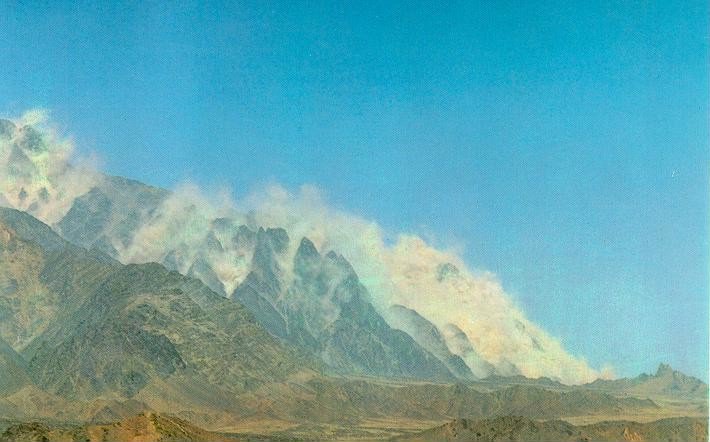
Pakistan conducts Chagai-I: five simultaneous nuclear explosions at the Ras Koh Hills in Chagai district, Balochistan. National celebration follows.
Pakistan conducts Chagai-II: a sixth nuclear test at Kharan desert, Balochistan. Pakistan is now an openly declared nuclear power.
International sanctions imposed. Pakistan is placed on various international watch lists.
Dr. A.Q. Khan publicly admits to running a nuclear proliferation network that supplied centrifuge technology to Iran, Libya, and North Korea. He is pardoned by Musharraf. The affair creates a global nonproliferation crisis.
Chagai-I
28 May 1998
Five simultaneous nuclear explosions rocked the Ras Koh Hills in Chagai, Balochistan. Pakistan became the seventh country in the world to test nuclear weapons, and the first Muslim-majority nation to do so. 28 May is now observed as Youm-e-Takbeer (Day of Greatness) in Pakistan.
Watch & Learn
Video of the 1998 Pakistani Nuclear Weapon Test
Archival footage from the Chagai-I nuclear tests conducted on 28 May 1998 in the Ras Koh Hills, Balochistan.
Youm-e-Takbir: Pakistan's Nuclear Tests at Chagai
A documentary account of the events of 28 May 1998, when Pakistan became the world's seventh declared nuclear power.
International Response
Sanctions
The United States, Japan, and several other countries imposed economic sanctions on Pakistan following the tests under the Glenn Amendment, causing significant financial strain.
Nuclear NPT Status
Pakistan, like India and Israel, has not signed the Nuclear Non-Proliferation Treaty (NPT). It maintains its deterrent as a sovereign right and out of existential security concerns.
A.Q. Khan Network
The revelation in 2004 that Dr. A.Q. Khan had sold nuclear technology to Iran, Libya, and North Korea severely damaged Pakistan's international standing and created a major global nonproliferation crisis.
Strategic Stability
Pakistan's nuclear doctrine is based on minimum credible deterrence, primarily aimed at deterring a larger conventional attack by India. The nuclearization of South Asia remains a major concern for global security analysts.